War Cinema and Female Protagonism: A Brazilian Perspective on “1917” and “Battalion”
This article, prepared by colleagues from the University of Brasília, compares the Anglo-American film 1917 and the Russian film Battalion in terms of female protagonism. Using the Bechdel test, the authors highlight the stark differences in the representation of women in war cinema—from their complete absence to the collective experience of female characters.
It is common for war films produced by Hollywood to prioritize male characters over female characters, such that women have little or no leading roles in most of these cinematic productions. An indicator of this is the predominance of male protagonists, monopolizing the most important dialogues, relegating women to secondary roles such as soldiers' girlfriends. For a more precise analysis of this finding, two films about the First World War, one of the greatest armed conflicts in history, were selected: one production from the United States and one from Russia, as these are two major powers that participated in the war.
Thus, the objective of this essay is to compare the British-American film “1917” (2019) and the Russian film “Battalion” (2015) regarding the presence or absence of female character protagonism. The choice of these two films (the selection of these two cases) is justified by the following criteria: 1) They were the highest-grossing, highest-budget, and most awarded films about the First World War in the 2010s in their respective countries; 2) They represent extreme cases regarding the presence/absence of female protagonism in war films, as well as gender representativeness of main and secondary characters.
A method by which female protagonism and representativeness in cinematic productions can be verified is the Bechdel Test. This is a technique created by cartoonist Alison Bechdel to evaluate the relevance attributed to women in film dialogues. To pass the test, a film must meet three requirements: 1) It must feature more than one woman with speaking lines; 2) The women must converse with each other; 3) The subject of their conversation must be something other than men. This may seem very simple; however, unfortunately, most Hollywood films do not pass the test. For example, out of the 100 most popular Hollywood films in 2011, only 3 passed the Bechdel Test (Stokes, 2013), which demonstrates a high degree of sexism in American cinematic productions.
The film “1917” follows the mission of two British soldiers tasked with crossing no-man's-land to deliver a crucial message capable of saving hundreds of lives. The female presence in the narrative is extremely limited, restricted to a French character who offers shelter and protection to the protagonist in her home.

As such, the work does not meet the criteria of the Bechdel Test, as it does not feature two named female characters who converse with each other. The plot structure, centered on the protagonist's individual journey through trenches, combat zones, and enemy territories, limits the insertion of other perspectives and reinforces an almost exclusive focus on his personal trajectory.
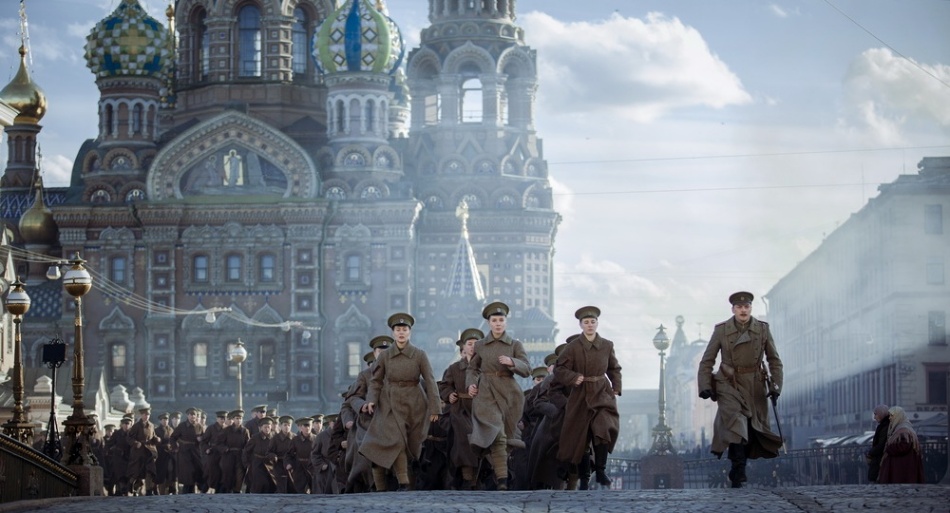
In contrast, the film “Battalion” focuses entirely on female characters, following their trajectories, the reasons that led them to military enlistment, their training, and their actions on the battlefield.
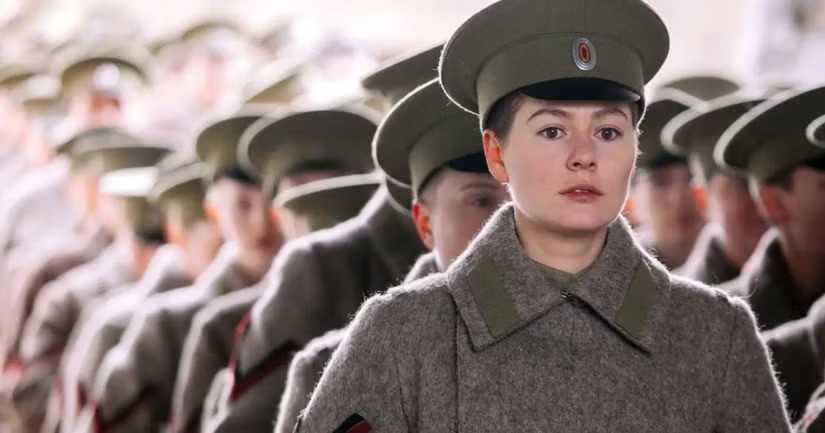
Male figures appear in smaller numbers and, to a large extent, remain in the background compared to the women's narrative. The film presents an explicit critique of the sexism and misogyny faced by the female combatants, both from soldiers and their superiors. The protagonists are portrayed as strong and multifaceted characters, constructed with complexity and depth. Additionally, the film introduces a subtle commentary on class divisions by bringing together women from diverse backgrounds, ranging from peasants to representatives of the aristocracy, in the same battalion.
It is important to highlight that while “1917” follows the individual journey of a single soldier, “Battalion” seeks to portray the collective experience of over a hundred women who actively participated in combat during the First World War. Despite the large number of characters, the film manages to develop each one consistently, granting them moments of protagonism and heroism that add new layers to the representation of war. Another striking difference is that “1917” renders women invisible, both on the battlefield and on the home front, whereas “Battalion” portrays female resistance to the sexism faced by women in society, which is also replicated in the armed forces.
Passing the Bechdel Test does not make a film feminist, as the three criteria can be satisfied even with low female empowerment, in less relevant dialogues of secondary characters. However, this method is valid for verifying the probability that a cinematic production is not markedly unequal in gender representation. Films like “Battalion” can inspire other cinematic productions (in general) and war films (in particular), as female protagonism, whether individual or collective, can be found in any part of society. When a film's intention is to portray wartime, in addition to men on battlefields or in war cabinets, which generally have male predominance, there is the female half of the population, who also experienced the conflicts by performing activities in various areas (industrial, agricultural, educational, health, espionage, and, to some extent, military and political as well). Nothing justifies gender inequality in cinema, as to perceive the protagonism of women, one only needs to look at the female half of the population.
Invited authors:
Robson Cunha Rael, PhD in International Relations (UnB)
Nicole Paroul Cansian, Bachelor's and Master's student in International Relations (UnB)
References:
1917. Direção de Sam Mendes. Roteiro: Sam Mendes; Krysty Wilson-Cairns. [S.L]: Dreamworks Pictures, 2019. (119 min.), son., color. Legendado.
BATALHÃO. Direção de Dmitri Dmitrijewitsch Meschijew. Roteiro: Ilya Vladimirovich Avramenko; Igor Ugolnikov; Evgeny Ayzikovich; Dmitry Meskhiyev. 2015. (120 min.), son., color. Legendado. БАТАЛЬОНЪ. Direção de Дмитрий Месхиев. Roteiro: Илья Авраменко
Игорь Угольников; Евгений Айзикович; Дмитрий Месхиев. 2015. (120 min). son. color. Legendado.
Stokes, Colin (2013). TedTalk com Colin Stokes: Como filmes ensinam masculinidade. Disponível em: https://www.youtube.com/watch?v=ueOqYebVhtc Acesso em 04/09/2025.
«Наукозация» стал победителем Конкурса лучших научно-популярных работ работников НИУ ВШЭ 2023 г.

Блог о том, как заниматься наукой и стать успешным молодым ученым: разбираем успешные и неуспешные примеры, делимся опытом (негативным и позитивным), а также обсуждаем последние новости и события. Специализация блога - исследования Латинской Америки и Ибероамериканского мира.

Комментарии