
Bolsonarismo in Brazilian Elections: a fake ideology as a strategy to manipulate voters and attain power
Lula da Silva of the Workers' Party (PT) and Flávio Bolsonaro of the Liberal Party (PL) are the two main candidates in the 2026 Brazilian presidential election. From an ideological spectrum perspective, this electoral contest appears at first glance to be a confrontation between the center-left PT and the far-right Bolsonarista movement, which was inaugurated by former President Jair Bolsonaro (who governed Brazil from 2019 to 2022).
But, given that legitimate right-wing and left-wing ideological currents contain ideas that contribute constructively to democratic political debate, categorizing Bolsonarismo as a genuine form of political ideology may be conceptually inappropriate. Bolsonarismo is characterized by an anti-left political stance, however, their leaders and followers do not oppose a real left-wing — the social-democratic PT — but rather challenge an imaginary construct, a fictitious "communist PT". Consequently, it constitutes a fake ideology grounded in false premises.
In the 2018 presidential election, then-candidate Jair Bolsonaro secured victory by disseminating a big lie throughout his campaign — specifically, the alleged imperative to "save Brazil from communism" [1].
This same fictitious communist threat formed a core element of his propaganda during his 2022 re-election campaign and continues to shape the 2026 presidential campaign of his son, Flávio Bolsonaro.
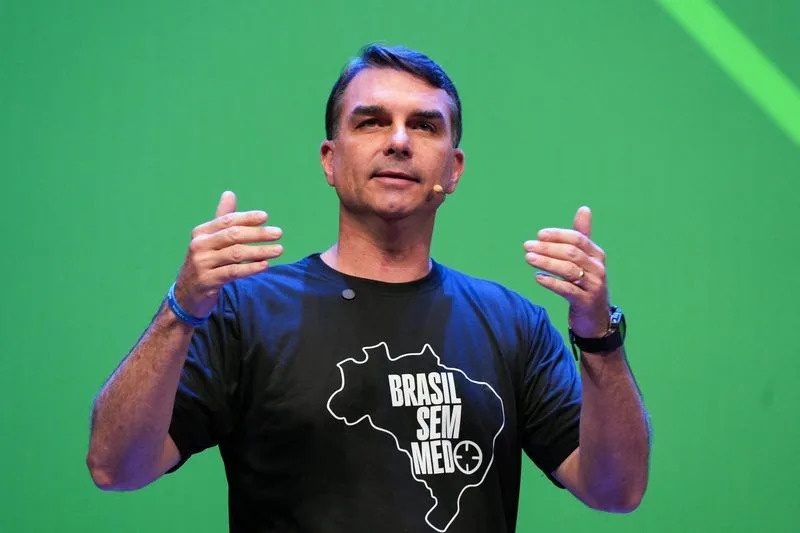
At the core of Bolsonarismo rests on systemic falsehood, persistently generated by a propaganda and fake news apparatus that benefits from biased algorithms on social media platforms controlled by Big Tech corporations. This dynamic ultimately culminated in crimes against humanity, notably through scientific denialism during the COVID-19 pandemic, as rendered in the judgment of the Permanent Peoples' Tribunal (which, despite lacking enforcement power, highlights facts and arguments) [3]. Then-President Jair Bolsonaro and his supporters trivialized the impacts of the COVID-19 virus — the largest public health emergency in a century — while portraying its main solution, vaccines, as highly dangerous. As a result, Brazil registered over 700,000 fatalities, with estimates suggesting that approximately 400,000 deaths could have been prevented were it not for the anti-science posture of the Bolsonaro administration [4].
In its pursuit of power, Bolsonarismo also engages in the instrumentalization of religious faith to secure political support, despite presenting a discourse fraught with contradictions. Clergy members, particularly within evangelical churches, utilize their places of worship for political campaigning in favor of Jair and Flávio Bolsonaro. Such religious interference in elections directly conflicts with texts deemed sacred by Christians, wherein Jesus Christ stated: "Render therefore unto Caesar the things which are Caesar's; and unto God the things that are God's" [5] (Matthew 22:21). Jesus may thus be interpreted as a precursor of laïcité, advocating for the separation of church and state. Contradictory, famous pastors who claim to adhere to biblical scriptures act as campaign agents for Bolsonarista politicians, fostering hostility toward an imaginary left [6].
It follows that individuals who accept the deceptions and contradictions of a pseudo-ideology become susceptible to accepting extreme actions, including an attempted coup d'état, such as the one that occurred in Brazil on January 8, 2023. Through an overtly Manichean discourse, Bolsonarismo incites the population to harbor fear and anger toward leftists [7], portraying them as inherently evil — a constructed representation of the left that is heavily distorted, disproportionate, and largely fictionalized. Although the PT warrants criticism for the corruption scandals of the Mensalão and Petrolão, numerous other political parties participated in the very same schemes, including the PL, Flávio Bolsonaro’s party. It is crucial to emphasize that the arguments presented here do not constitute an apology for the PT, but rather an empirical analysis centered on the primary determinant of politics: power.
In Political Science, power represents the central concept, whereas ideology functions as an auxiliary concept among many others. As Harold Lasswell noted, politics is fundamentally about “who gets what, when and how” [8]. First, to win elections and govern effectively, the PT has historically distanced itself from left-wing sectors and aligned with right-wing interests. Consequently, PT leaders such as President Lula compromise their ideological stance to attain and sustain power.
During Lula’s initial two presidential terms (2003–2010), his Vice President was José Alencar, a businessman affiliated with the PL, who was added to the ticket to reassure financial markets that the PT administration would not enact radical left-wing policies. In the 2010 election, President-elect Dilma Rousseff received support from Fernando Collor, the right-wing former president who had defeated Lula in the 1989 presidential election. During his third term (2023–2026), Lula relied on the support of Davi Alcolumbre (of the União Brasil party) as President of the Federal Senate and Hugo Motta (of the Republicanos party) as President of the Chamber of Deputies — both politicians from right-wing parties. Another indication of ideological pragmatic divergence is the attenuation of an issue that gradually receded on the PT’s agenda: agrarian reform, which was heavily emphasized during the 1990s. Notably, had this policy been intrinsically communist, it would have called for an agrarian revolution rather than reform.
Second, when the PT does reflect an ideology within its public policies, that ideology is social-democratic rather than communist or socialist — especially following the breakaway of more radical internal factions that subsequently founded further left parties, such as the PSTU (1994), PCO (1995), and PSOL (2004). PT-led administrations operate under a social-democratic framework because they accept capitalism while establishing social safety programs to mitigate the systemic inequalities generated by the market economy. Foremost among these initiatives is the Bolsa Família cash transfer program, designed to redistribute income to impoverished households. Labor rights, public education, and healthcare also constitute primary elements of the PT platform. Notably, the PT functions as the main social-democratic party in Brazil, given that the PSDB (Partido da Social Democracia Brasileira), despite its name, is predominantly neoliberal, as demonstrated by the privatization of state-owned enterprises under President Fernando Henrique Cardoso administration (1995–2002). Regarding foreign policy, relations with Cuba and Venezuela do not denote a socialist or communist orientation; the United States and the European Union hold vastly greater diplomatic significance on the PT’s international agenda. Furthermore, in 2026, President Lula attended the G7 Summit by invitation for the tenth time [9], engaging directly with the principal Western capitalist economies (and Japan).
The PT also committed missteps by engaging in excessive opposition during the PSDB presidential terms, initiating the "Get out FHC" (Fora FHC) campaign in April 1995, merely four months after President Cardoso took office following a first-round electoral victory in October 1994 [10]. While the PSDB administrations merited criticism — such as for exchange-rate populism that damaged the Brazilian economy — the magnitude of the PT's rejection was uncalibrated. From the late 2010s onward, the quality of Brazilian political discourse deteriorated further, with Bolsonarismo emerging as the most severe manifestation of democratic fragility in the country. Brazilian democracy requires maturation so that political rivals no longer treat one another as existential enemies. Politics involves not merely talking with those in agreement, but fundamentally engaging in dialogue with dissenting voices. Furthermore, because it is impossible to satisfy all interests simultaneously, democracy seeks to address different majority wills at distinct moments. Ultimately, besides to avoid fake ideologies, understanding political dynamics requires focusing primarily on power relations rather than adhering rigidly to ideological constructs.
References:
[2] https://hcommons.org/app/uploads/sites/1002664/2021/12/meinkampf.pdf
[3] https://comissaoarns.org/documents/44/TPP-Sentenca-Bolsonaro-PORT-anexos.pdf
[6] https://www.youtube.com/watch?v=4uBxAl-rPyw
[7] https://www.youtube.com/watch?v=EMNkp5rECMg
[8] https://archive.org/details/politicswhogetsw0000haro/page/n3/mode/2up
[10] https://fundacaofhc.org.br/acao-politica/uma-oposicao-implacavel/
Invited author:
Robson Cunha Rael, PhD in International Relations (UnB)
«Наукозация» стал победителем Конкурса лучших научно-популярных работ работников НИУ ВШЭ 2023 г.

Блог о том, как заниматься наукой и стать успешным молодым ученым: разбираем успешные и неуспешные примеры, делимся опытом (негативным и позитивным), а также обсуждаем последние новости и события. Специализация блога - исследования Латинской Америки и Ибероамериканского мира.

Комментарии